

Finding Google Voice alternatives is now a top priority for many clinical research teams.
Why? Clinical research teams want reliable, compliant communication that reaches participants quickly, keeps data flowing, and does not raise red flags with IT or compliance departments.
This is far more achievable today than it was even a few years ago, because purpose-built research communication platforms now exist that are designed specifically for regulated environments.
When we speak to research coordinators, they tell us that Google Voice is often an easy starting point. It is familiar, quick to set up, and free or inexpensive. That convenience is exactly why so many teams begin there. It is also why many eventually leave.
We are now seeing a steady flow of teams replacing Google Voice after messages get blocked, accounts get flagged, or internal IT teams step in and shut things down. The issue is that Google Voice was never built to support structured, high-volume, or regulated communication.
Clinical research teams are now avoiding:
- Consumer tools that are not designed for regulated environments.
- Messaging platforms with inconsistent delivery at scale.
- Systems that raise IT or compliance concerns after deployment.
They are replacing Google Voice with:
- Mosio, a purpose-built communication platform for clinical research.
- Tools designed for compliant, high-volume participant messaging.
- Systems that support automation and oversight by default.
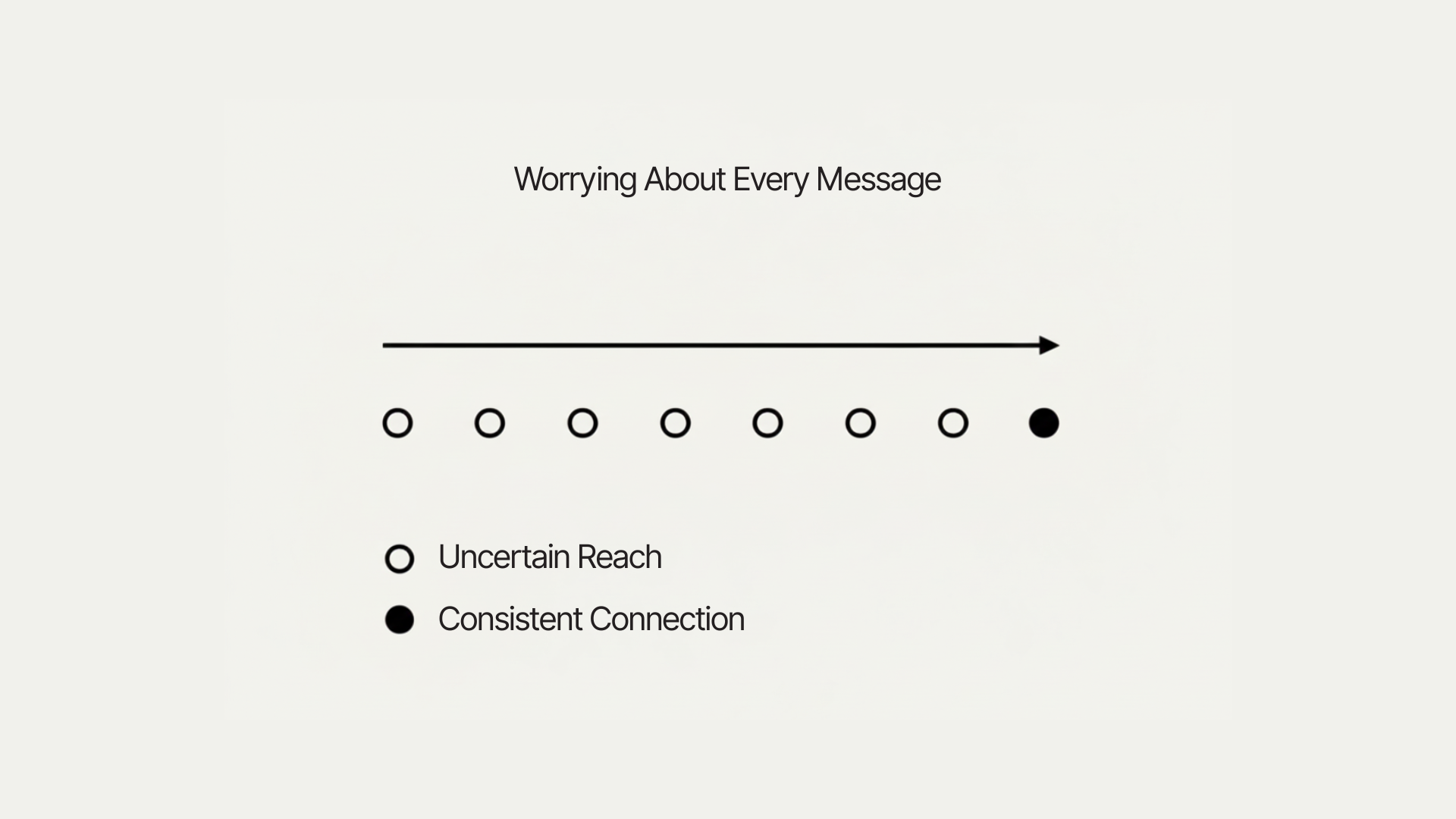
What if you never had to wonder whether a participant received a message or whether your tool would raise compliance concerns?
After reading this article, if you feel a sense of relief, knowing there are purpose-built alternatives to Google Voice for clinical research, take this as a sign to move forward with Mosio.
Why Google Voice Alternatives Are Now Used By Researchers
Not long ago, I met a researcher for coffee who seemed relieved just to talk it out.
As we talked about his day-to-day work, the topic of participant communication came up almost casually. He mentioned that staying in touch with participants had become more complicated over time, especially as studies grew and schedules got busier.
He described relying on tools that were easy to start with but harder to trust as volume increased. Sometimes messages went unanswered, and it wasn’t always clear whether they had been delivered or missed entirely. This added friction to work that already required careful coordination.
There wasn’t a single incident that prompted concern. Instead, it was a gradual realization that the communication tools he was using weren’t designed with research workflows or regulatory expectations in mind. What worked early on no longer felt like the right fit.
That conversation reflects what many research teams are experiencing today. Google Voice is often the right place to start, but as research operations scale, teams often begin looking for alternatives built specifically to support clinical research communication.
What To Look For In A Google Voice Alternative
The clinical research coordinators I speak with want Google Voice alternatives that meet three criteria:
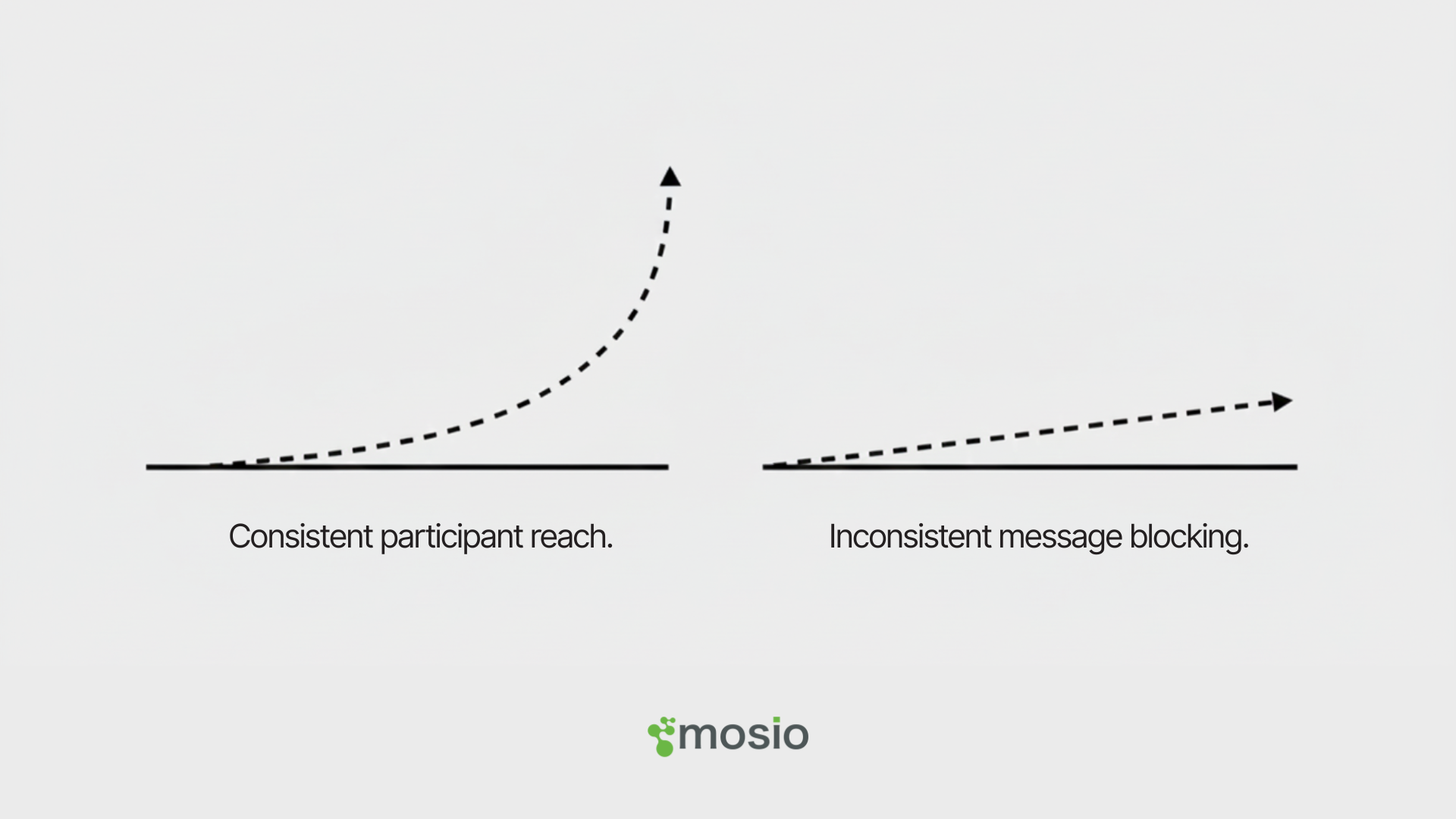
- Delivers messages consistently, even at higher volumes.
- Supports approved use by design.
- Includes built-in automation.
These are three non-negotiables.
If messages are getting blocked, delivery feels uncertain, and compliance questions keep surfacing, how long can your team afford to rely on a tool that was never built for clinical research?
In practice, this means moving away from general-purpose messaging tools and toward platforms built specifically for research communication.
An effective Google Voice alternative for clinical research should make consistency the default. Messages must go out when scheduled, arrive reliably, and support two-way communication without coordinators having to constantly check, resend, or follow up manually. As message volume increases, reliability should improve.
Approved use also needs to be built into the system itself. Research teams should not have to explain or justify their communication workflows after the fact. The platform must support regulated use by design, with clear structure, visibility, and controls that align with how studies actually operate.
Automation is the final requirement, and often the deciding factor. We know that manual texting, phone calls, and emails do not scale. A good platform allows teams to configure reminders, alerts, surveys, and follow-ups once, then let those workflows run in the background. This reduces repetitive work, limits errors, and frees staff to focus on higher-value tasks that require human judgment.
This brings us to Mosio. Instead of adapting consumer tools to fit research workflows, we designed Mosio to support them from the start.
This means you can expect:
- Reliable SMS delivery
- Automated messaging schedules
- Two-way communication
- Easy integration with REDCap
I thought back to that coffee conversation as we talked through what “better” really meant. He wanted communication to feel steady again. Something that did not require extra thought at the end of a long day or added concern as enrollment increased.
He described the change as subtle but meaningful. There were fewer moments of uncertainty about whether a message went out. Fewer quiet gaps where a response should have been. Less energy spent thinking about the tool itself. Once messaging became reliable, it faded into the background and allowed him to focus on the work that mattered.
That is when communication stops creating friction and begins supporting the study. It becomes something teams can trust as studies grow, without constant checking, adjusting, or explaining.
3 Worst Case Options That Look Fine At First
What happens when a Google Voice replacement solves one problem but introduces several new ones?
In practice, teams often cycle through the same three types of options:
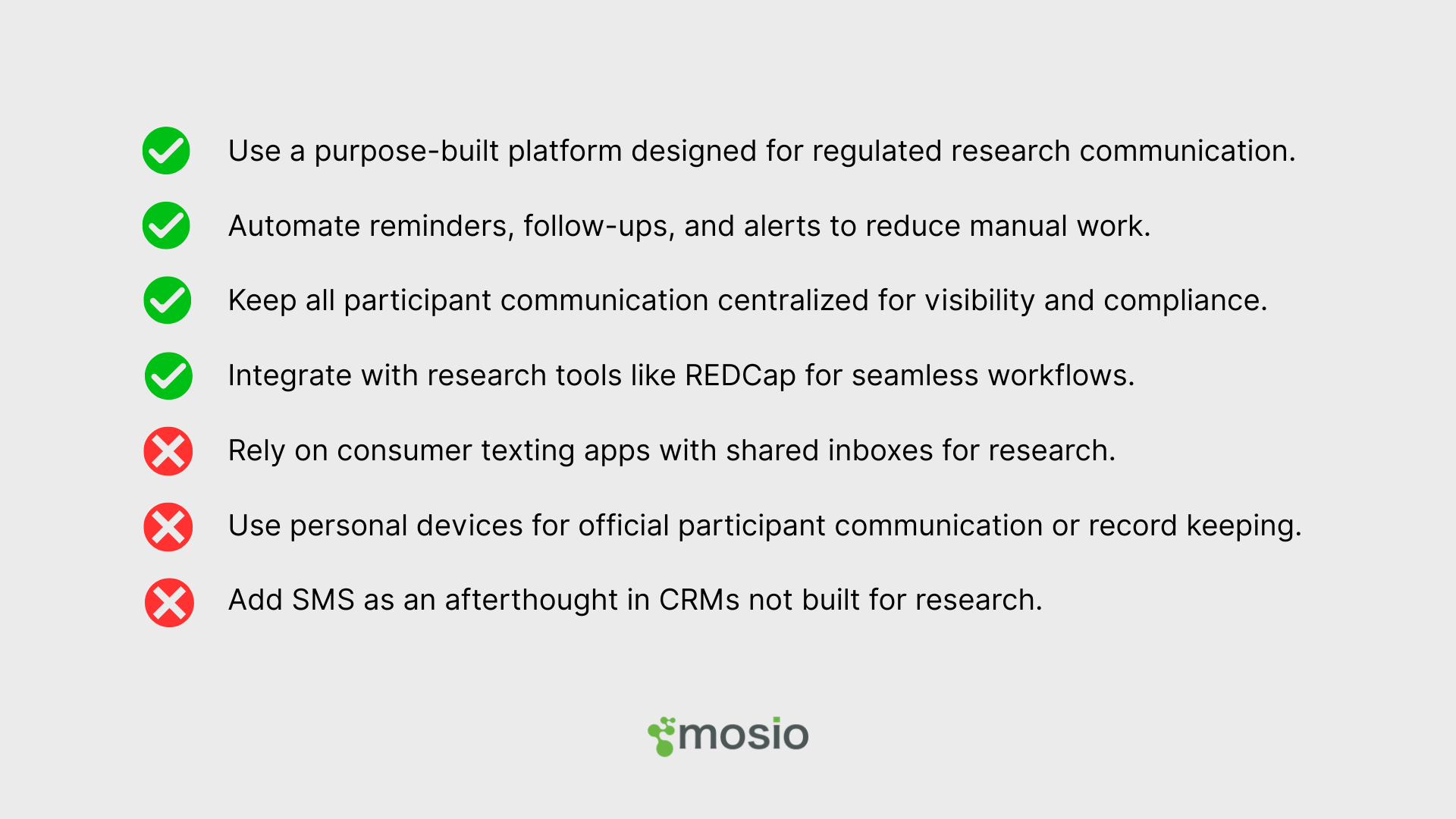
- Consumer texting apps with shared inboxes.
- CRM platforms with SMS added as a side feature.
- Personal device-based texting solutions.
We’ve found that some alternatives appear workable in the short term, especially when teams are under pressure to move quickly. Consumer texting apps with shared inboxes are a common example. They promise simplicity, but they often rely on unofficial messaging paths and lack the controls needed for regulated work. Coordinators tell us these tools attract the same scrutiny from IT and compliance teams that caused issues in the first place.
Other teams turn to CRM add-ons that include SMS as a secondary feature. These systems are usually built for sales or customer support, not back-and-forth research communication. Texting becomes buried among dashboards, workflows, and features that add cost and complexity without improving participant outreach a great deal.
Personal device-based solutions create another set of challenges. In our experience, this rarely works. When staff use their own phones or numbers, message history becomes fragmented. Oversight is limited, and continuity breaks as roles change or team members leave.
Why So Many Teams Move From Google Voice To Mosio
Many Mosio clients start with Google Voice for one simple reason… it’s easy. And they switch for equally simple reasons:
- Messages stop going through.
- Accounts get flagged or blocked.
- IT departments step in and shut it down.
Mosio replaces Google Voice with something that feels just as simple on the surface but far more durable underneath.
Setup is fast and training is minimal. Participants and recipients do not need to download anything or learn a new interface.
Teams gain visibility into every message sent and received. They can export records, monitor engagement, and prove compliance when required.
Instead of hoping messages are delivered… they know they will.
Can You Afford To Keep Using Google Voice?
Of course, you can’t! Google Voice is rarely a deliberate long-term choice. It is usually a temporary fix that becomes permanent by accident.
Switching to a purpose-built alternative is a deliberate decision to reduce uncertainty. It is a move toward reliability, visibility, and sustainability.
If Google Voice is starting to feel fragile, limited, or risky, that is not a failure on your part. It is simply a sign that you have outgrown it.
Over 150 million reminders, alerts, and surveys have been sent with Mosio.
If you’re ready to automate your research communications, get started with Mosio today.